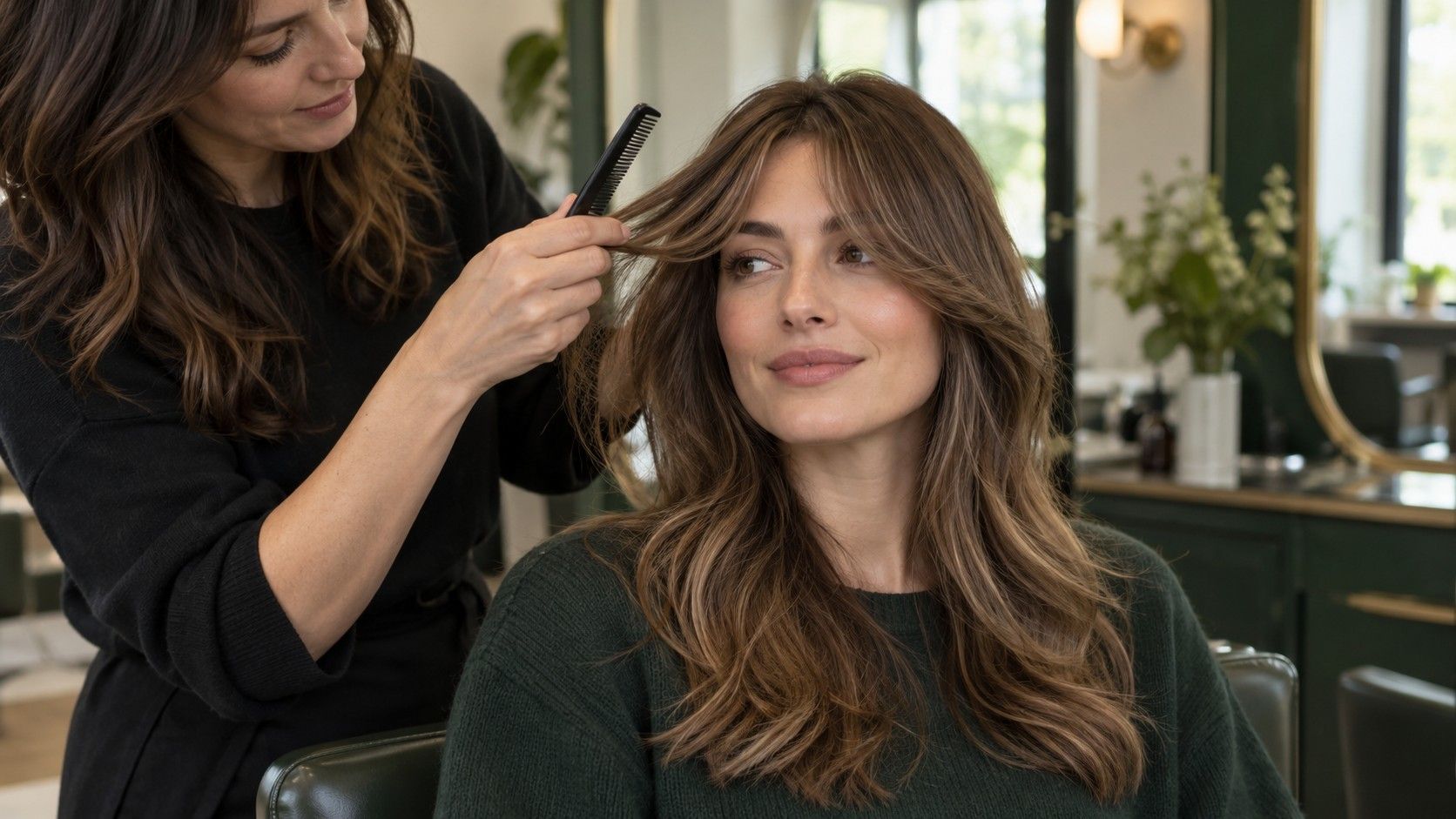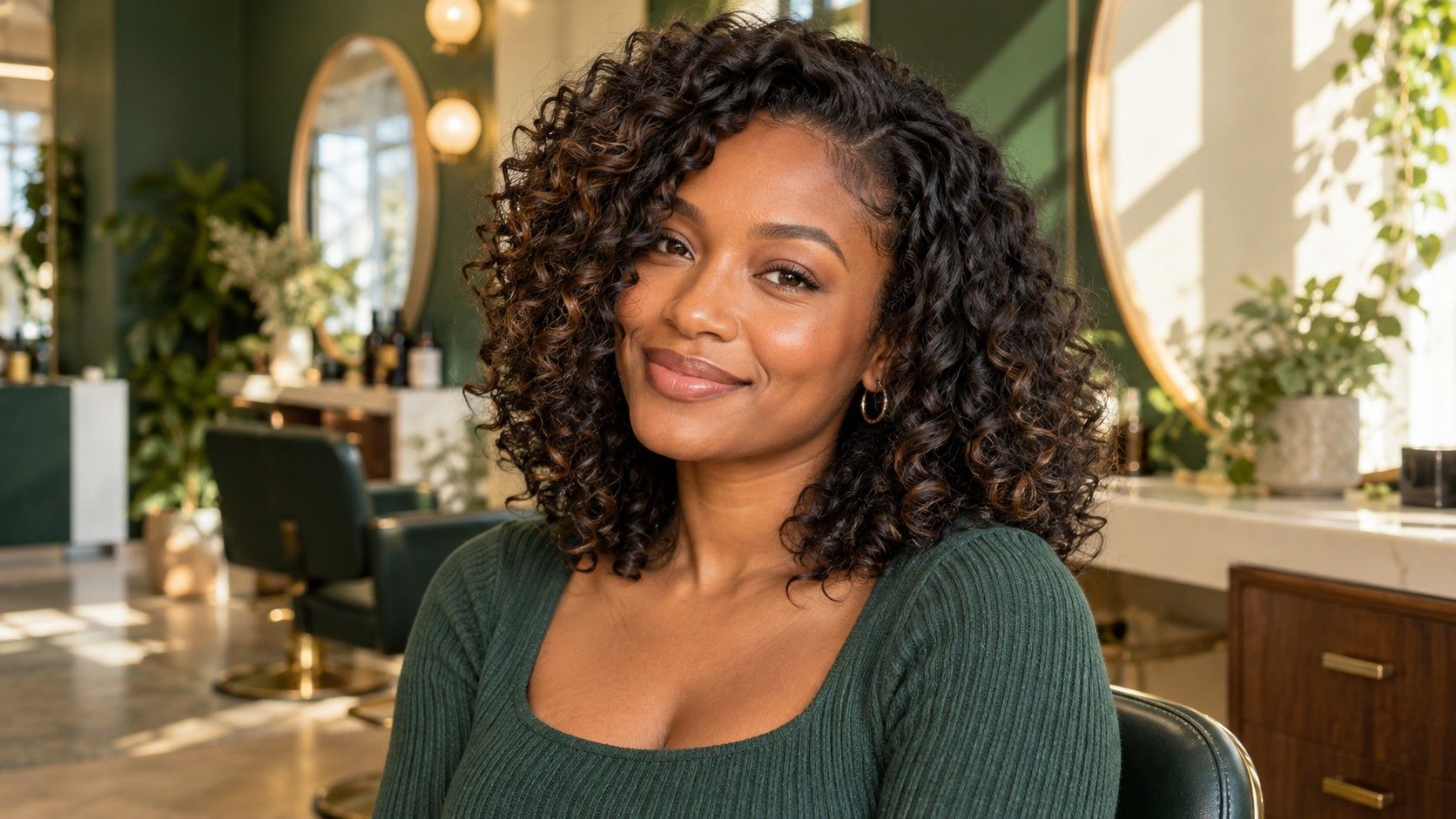
When looking at hairstyles for diamond faces, I pay less attention to the label than to where the hair actually lands. Cheekbones may form the widest part of your outline, with a narrower forehead and a tapered chin, but that leaves plenty of room for different cuts. A sleek bob can show those lines; a loose fringe can soften the outline around them. The useful question is which effect you like, and whether your hair will hold it after an ordinary wash.
Check the outline with your usual hair out of the way
Pull the front sections back loosely and look in a mirror at eye level. Compare the width across your forehead, cheekbones and jaw. If the cheekbones appear widest and the outline narrows above and below, diamond is a useful description. You do not need precise measurements or a perfectly pointed chin. A face can sit between diamond and oval, and a widow's peak can change the impression at the forehead without changing the rest of the outline.
I would use a photograph taken from a comfortable distance as a second view, rather than judging a close selfie. Camera position and a tilted chin can make the lower face look much smaller. Check the profile as well: the way the front hair falls beside the nose and jaw may matter more to your haircut than the label you choose. Keep the photograph unfiltered and wear the parting you actually use.
Then decide what you want to see. Perhaps you like the clean line of your cheekbones and want them visible. Perhaps you prefer some movement around your temples when the hair is tied back. Neither choice is a correction. Write down the effect in plain language before collecting references: “open sides, longer front” is a much clearer starting point than “make my face a different shape.”
Put the ends where you want the eye to pause
A bob ending around the mouth or jaw creates a different outline from one ending at the cheekbone. Try folding the bottom of your hair under and moving the temporary edge up and down. Notice when the cheekbones become more visible and when the ends gather beside the jaw. This rough test cannot predict a finished cut, but it can show whether you enjoy a strong horizontal edge close to your face.
For a chin-length bob, ask how the corners will sit when the hair is dry. A blunt edge can look deliberate and graphic, especially with a clean parting. A lightly softened perimeter may move more freely, although too much thinning can leave fine ends looking sparse. If you normally tuck one side behind an ear, test that version too. The exposed side will tell a different story from a symmetrical salon photograph.
Shoulder-length hair offers more room to place the first visible layer below the cheekbone. That can be useful if short front pieces repeatedly fall into your eyes. It also preserves some tie-back options. Longer hair is not automatically easier: heavy lengths can flatten the crown, while a shoulder-grazing edge may flick against a coat collar. Take your everyday clothes and routine into account, rather than choosing length from a face-shape chart alone.
| Detail to test | What to observe | Question for the stylist |
|---|---|---|
| Jaw-length edge | Where the corners sit beside the chin | Will this turn inward without a brush? |
| Longer front layers | Whether the cheekbones stay visible | Can these still reach behind my ears? |
| Shoulder-length cut | Collar flips and tie-back length | Where will the dry ends settle? |
| Short crop | Temple coverage and fringe direction | What will the sides do as they grow? |
Choose fringe by the opening it leaves
A fringe changes the visible forehead, so its opening matters as much as its length. A long curtain fringe can leave a small central gap and more hair beside the temples. A side-swept piece creates an uneven frame. A blunt fringe forms a clearer line across the upper face. All can work with a diamond outline; the choice depends on whether you enjoy an open forehead, a covered forehead or something between them.
Hold a front section across your forehead before cutting. Check it with glasses on if you wear them, and turn your head to see whether the ends sit on the frames. Curtain pieces may fall at the cheekbone in a styled photograph but drop into the middle of the face when the roots lose lift. Ask to see the proposed shortest point and the point where the fringe joins the side layers. Those two lengths determine much of the daily experience.
A cowlick can separate a dense fringe or push one corner upward. That does not rule fringe out, but it may favor a lighter, longer shape that follows the growth direction. I would ask the stylist to examine the hairline before the hair is saturated or smoothed into place. If your preferred fringe needs a brush and dryer every morning, make that an explicit choice. A long fringe still needs attention when it constantly brushes your eyelashes.
Let texture decide how much layering is useful
On straight, fine hair, a solid lower edge can preserve the appearance of density. Face-framing layers may be enough to introduce movement without cutting shorter pieces throughout the head. Ask how much hair will be brought forward into the frame: a broad section can remove more weight from the perimeter than you expect. Compare the planned cut with your own hair when it is freshly washed and when it is flatter the next day.
With waves, observe where the first bend appears beside the face. A layer that looks safely below the cheekbone when stretched may spring upward when dry. A useful consultation includes your normal drying method, whether that is air drying, diffusing or a brush. Ask for the front to be checked in its finished dry state. The goal is a comfortable resting point, not a particular wet measurement.
Dense curls may create width around the cheekbones simply because that is where the curls expand. You can enjoy that volume, shift some of it through shaping, or keep a longer outline that carries more weight. Taking out large amounts of hair indiscriminately can create unwanted short pieces, so discuss the shape rather than asking for “less bulk everywhere.” Bring a reference with a comparable curl size and show how much shrinkage your own hair has.
Compare the cut loose, tucked and tied back
A haircut earns its place in the week outside the mirror at the salon. If you wear a low ponytail for work, the loose pieces around the temples become the visible haircut. Ask which sections will escape the elastic and where they will end. A short cheekbone layer can look lovely loose and feel irritating during exercise. Keeping that section long enough to tuck away may be the better compromise for you.
Try a center part and a modest side part before changing the whole cut. A side part can bring more hair across one temple; a center part can make the frame feel more even. Neither has to be permanent. Check whether your natural growth returns to its old position after you run your fingers through it. If moving the part requires considerable heat styling, include that work in your decision.
For a short style, look at the ear area and nape as carefully as the fringe. Leaving a little length around the temples creates a different silhouette from close sides, and both will reveal the cheekbones differently. Your earrings, glasses arms and tolerance for hair touching the ears are useful practical details. Ask to see a back view of any reference so a compelling front image does not hide a shape you would dislike wearing.
Leave the appointment with a cut you can reproduce
Bring two or three references and identify a specific feature in each: the jaw-length edge, the open fringe or the softly curved sides. Also bring one image that misses the mark and explain why. This helps separate a hairstyle you admire from one you want on your own head. Avoid asking the stylist to copy all the details from several incompatible cuts at once.
Before cutting, agree on the shortest front piece, the amount taken off the back and the styling you are prepared to do. If the plan depends on regular fringe trims, ask when the shape usually starts to feel different and how appointments are arranged. Timing varies with growth and the cut, so a personal plan is more useful than a fixed schedule taken from an article.
Watch the finishing steps. Notice which direction the fringe is dried, whether the roots are lifted and how little or how much product is used. Then ask for a simpler version for rushed mornings. Haircuts for a diamond face offer plenty of room for experimentation; a clear agreement about length, texture and effort gives that experiment a far better chance of becoming a haircut you enjoy.