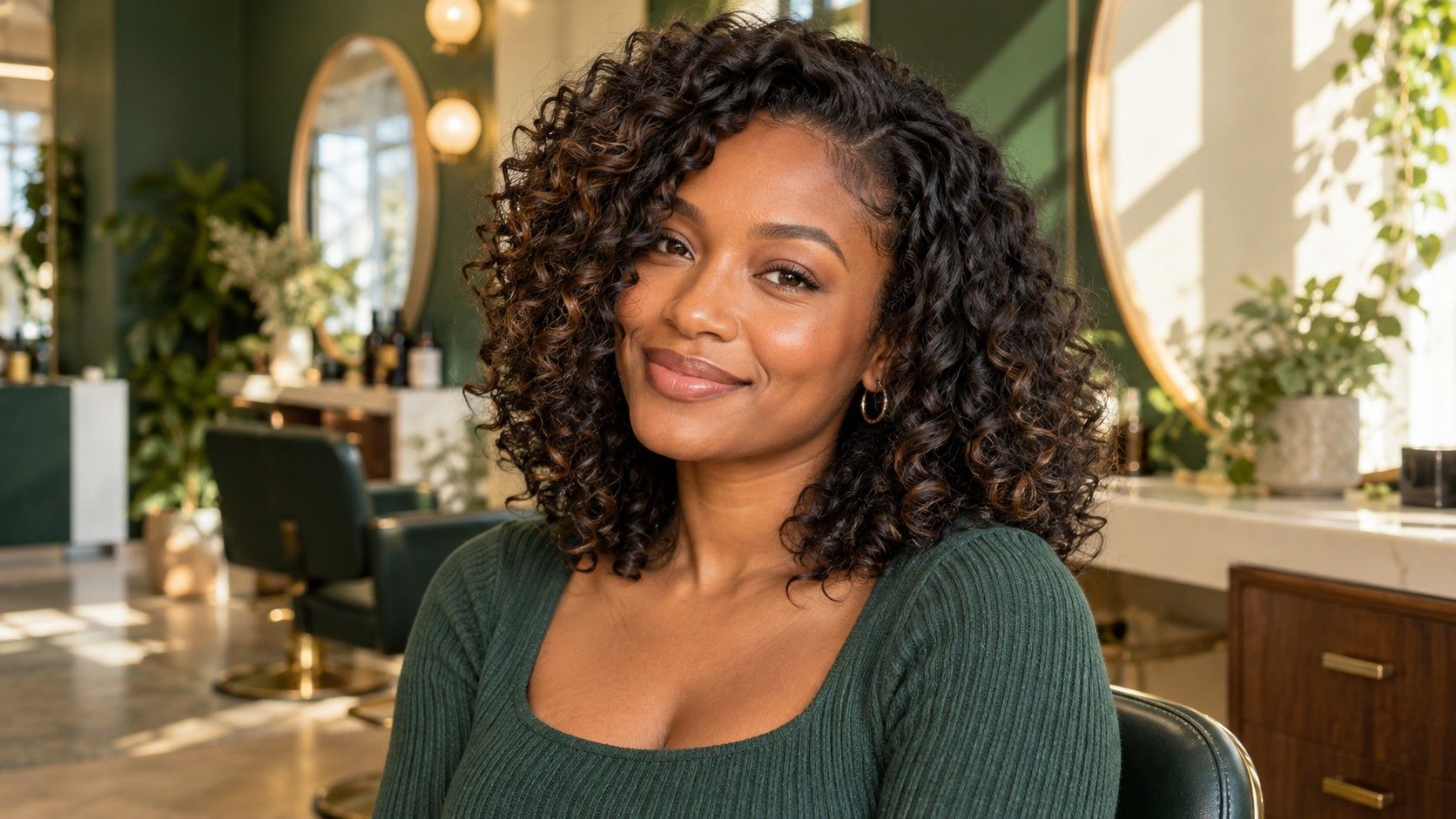
With curls, the outline you see after drying matters more than the length held between a stylist’s fingers. A fringe can rise, a side section can expand, and two curls beside each other can settle at different heights. I would use face shape to choose where I want volume, then let the actual curl pattern decide how the haircut can get there.
Bring your everyday curls to the consultation
Ask the salon how they want your hair prepared. A stylist may need to see it dry and naturally arranged, or may have a particular preparation process. Describe your routine honestly: washing frequency, detangling, the products you usually use and whether you diffuse or air-dry. A cut assessed only in a stretched or heavily manipulated state gives limited information about the silhouette you expect at home.
Photograph your hair on a wash day and again on a later day that you consider wearable. Use similar light and camera distance, with a front, side and back view. Notice whether the crown flattens, one temple expands or the nape keeps a tighter pattern. These observations help explain a concern such as “the sides get wide by lunchtime” more clearly than a face-shape name alone.
Check the length of the front in its relaxed dry state before any section is pulled straight. Do not assume every curl has the same shrinkage. Heat history, different patterns across the head and how the hair is handled can affect its fall. Tell the stylist if you also wear your hair stretched or straight, because a shape designed for one finish may look different in the other.
Choose where you want width, then look at the whole outline
If your face appears long to you, compare some width beside the cheeks with a taller, narrower outline. Hold the side curls outward gently rather than pulling the roots tight. If your face appears round, compare that with a little more height and a less expanded silhouette at cheek level. These are experiments in proportion, not instructions to disguise your features. You may prefer the wider option simply because it feels like you.
A square jaw can sit beautifully inside a rounded curl shape. It can also look strong beside a more compact cut. For a heart-shaped face, fullness near the lower cheeks or jaw may be an appealing balance to a broader forehead. With a triangular outline, you might prefer more presence near the temples. Try these arrangements with clips before treating any of them as a prescription.
Stand far enough from the mirror to see your shoulders as well as your face. A cut that seems broad in a tightly cropped selfie may look balanced in person. Your neck, shoulder line and preferred clothing also affect how the silhouette reads. Ask to see the back: a shape that frames the front nicely can still feel too flat at the crown or heavy at the nape.
Make layers solve a specific weight problem
Curly face framing layers can release movement around the cheeks while leaving length elsewhere. Shorter layers across the crown can create another kind of silhouette. Before agreeing to either, identify the problem you want solved. Is the bottom forming a heavy shelf? Does the top sit flat? Do the front curls fall into your eyes? Each question involves a different area and should not receive an automatic all-over answer.
Ask the stylist to explain how much density will remain in the perimeter. Removing a large amount of weight may make dense curls easier to arrange, but sparse ends can look even lighter when separated into curl groups. Fine curls and loosely waved sections may respond differently from tightly coiled areas on the same head. “More layers” does not specify which of these needs attention.
I would also ask how the shape will be checked dry, even if part of the service happens wet. The point is to inspect the result in a relevant state, not to insist that one technique suits everyone. Watch for a very short front section hidden among longer curls. It may spring forward later, once the carefully arranged salon finish relaxes.
Treat a curly fringe as a separate decision
A fringe changes the frame close to the eyes, where small shifts in length are noticeable. Decide whether you want curls touching your eyebrows, a shorter open fringe, or longer pieces that sweep aside. Show the desired dry position with your hand. A photograph of a stretched curl is a poor length reference unless you plan to wear it stretched every day.
Check your hairline and the direction the front curls naturally choose. A cowlick may open a gap; a cluster of tighter curls may sit higher on one side. These details are not faults that a cut must erase. They are reasons to discuss a flexible outline instead of a rigid horizontal edge. If you wear glasses, see how the front curls rest against the frames and whether they obscure your view.
Ask about the in-between days. Some people are happy to dampen and rearrange a fringe separately; others want the whole head left alone until the next wash. If your routine is the latter, a longer frame may be easier to live with. A fringe that looks lovely just after diffusing can become a different proposition after sleep or under a hat.
Check the cut against the way you actually dry it
The amount of side volume changes with drying and handling. Compare your usual result with a reference that has similar curl grouping and density, rather than matching hair colour alone. A broad, brushed-out finish and a finish with tightly defined groups can show the same cut in very different ways. Decide which version you want to maintain before asking for its outline.
If you diffuse, show the stylist the setting and technique you normally use or describe it precisely. If you air-dry, mention whether you move the part, clip the roots or leave the hair untouched. Ask which part of their finish depends on a step missing from your routine. That question is more useful than requesting a low-maintenance cut without explaining what maintenance means to you.
Consider friction and compression as well. A scarf, helmet, collar or favourite sleeping arrangement can change how curls sit near the face. Try tucking the front back and letting it fall again before leaving the salon. You need to know whether the shape recovers naturally or requires restyling. Neither outcome is inherently wrong, but one may suit your week better.
Agree on landmarks and review after a normal wash
A practical request might be: “Keep enough length for my usual loose tie, reduce the weight below my ears, and let the front curls finish below my cheekbones when dry.” Then let the stylist assess whether your pattern supports that plan. Be clear about which constraint matters most if those goals compete. Tying the hair back and having a short, full face frame can require compromise.
Take reference pictures that show the sides and back, including one example of what you dislike. Explain the reason: too much height, exposed ears, a heavy lower edge or front pieces too short to secure. You are not asking the stylist to reproduce another person’s curl pattern. You are using pictures to agree on volume and proportion.
After your next ordinary wash, inspect the cut with the products and drying method you normally use. Record a specific issue if one remains, such as one section covering an eye or an uneven-looking outline in its dry state. Ask the salon about adjustment arrangements rather than repeatedly cutting individual curls at home. A useful curly haircut supports a range of normal days; it does not need to freeze every curl into the same position.