Choosing bangs for your face shape is partly a question of proportion and partly a question of what happens before breakfast. A fringe may look right in a reference photograph and still need more drying than you want to do. I would decide how much forehead you want to show, where you can tolerate the ends touching, and how your hairline behaves before choosing a fringe name. Those checks make the difference between an appealing image and a haircut you enjoy wearing.
Decide what you want the fringe to do
Stand at an eye-level mirror with your hair pulled back loosely. Would you like a line across the forehead, an opening in the middle, or a sweep to one side? Use your fingers to bring a small section forward and compare those shapes. A few loose strands suggest a lighter effect; a broader section creates more coverage. This test is imperfect, but it helps you describe what attracts you to a reference.
Think about touch as well as appearance. Some people dislike hair on their eyebrows or eyelashes. Others find longer corners annoying against their cheekbones. Put your glasses on and try the shape again. Frames can push fringe ends upward or separate them, so a photograph without glasses may miss an important part of your everyday face. If you often wear a helmet or hat, consider how the fringe will look after it has been pressed flat.
Then set a realistic styling limit. Five quiet minutes with a dryer is different from leaving the hair to settle while you get dressed. If you have never styled a fringe before, ask the stylist to demonstrate the proposed routine before committing to a very short or dense cut. A fringe that requires attention is not a bad choice; it should simply be a choice you have made knowingly.
Compare the opening, density and shortest point
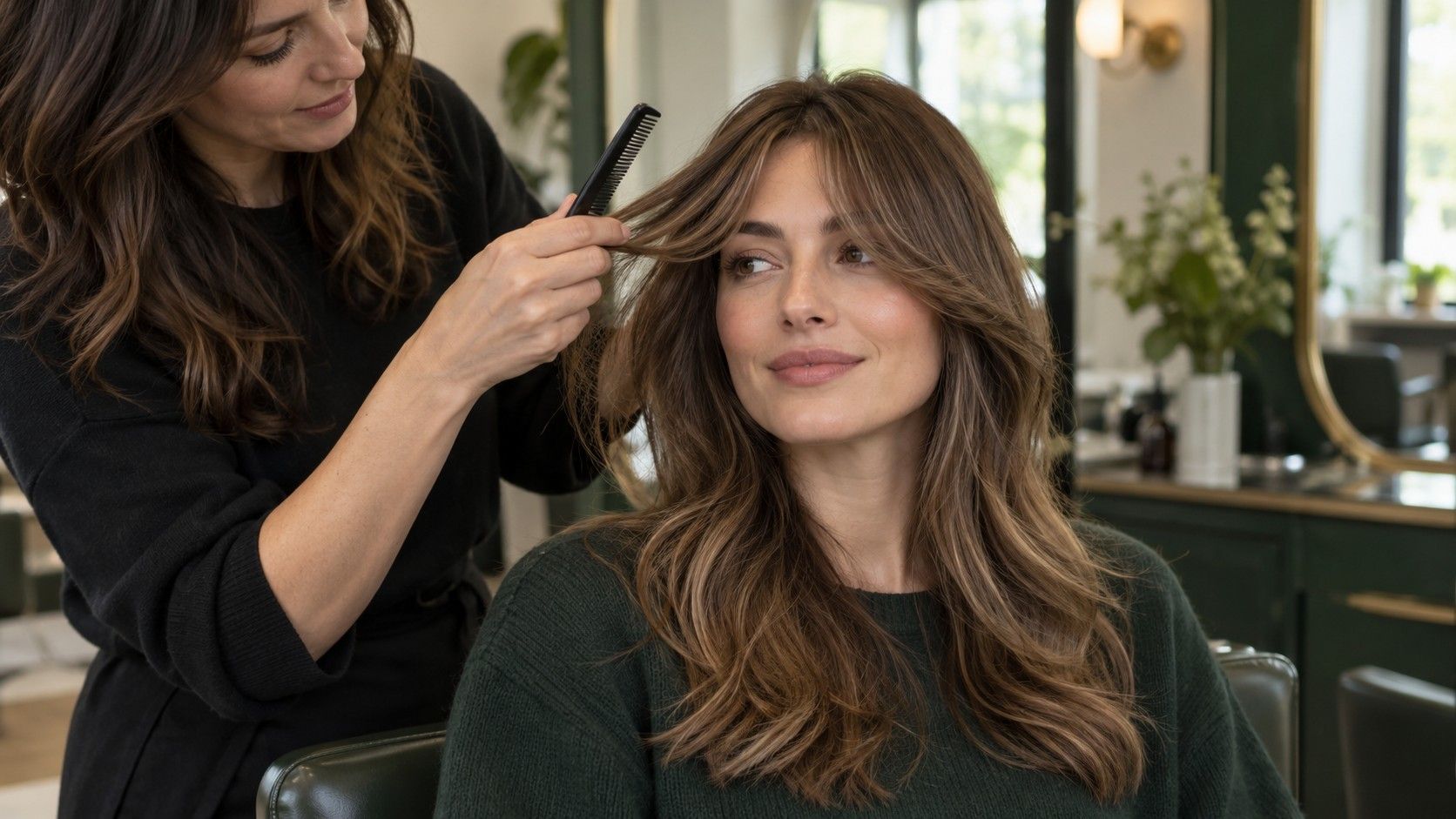
Names such as curtain, wispy and side-swept describe broad families rather than exact cuts. A curtain fringe can have a short central piece or start much lower beside the nose. A wispy fringe may be nearly transparent or dense enough to make a definite line. Ask to see where the shortest point will sit when dry, how wide the fringe section will be, and how the sides will join the rest of the hair.
A blunt fringe gives a stronger horizontal edge. A broken or lightly separated edge leaves more forehead visible between the strands. A side sweep moves the opening away from the center and may work with an established parting. None of these effects belongs to only one face shape. The table is a way to compare the practical differences before discussing a particular version with a stylist.
| Fringe direction | What you will see | What to test first |
|---|---|---|
| Blunt across the forehead | A clear upper frame | Cowlicks, density and brow contact |
| Light and separated | More forehead through the fringe | Whether fine strands separate comfortably |
| Curtain opening | A gap with longer side pieces | Center growth and the shortest dry length |
| Side sweep | A diagonal opening | Natural parting and eye contact |
| Long face frame | More open forehead and mobile sides | Tucking, ponytails and cheek contact |
Take the perimeter of the rest of the cut into account. A heavy fringe with a very light, thinned-out length creates a different balance from the same fringe with a solid bob. Ask how much hair will be moved into the fringe section, especially if your front hair is fine. Cutting a deeper section can reduce the amount left around the sides, and those side pieces may be the parts you most want to keep.
Use face proportions as preferences, not restrictions
If your face looks rounder and you enjoy some vertical openness, compare a central gap or longer sweeping pieces with a full straight fringe. You may still prefer the graphic effect of the full fringe. On a longer outline, covering more forehead can make the visible face feel shorter, while a very high central opening can emphasize length. Test the effect with your own hair instead of assuming one option is universally better.
For a square or rectangular outline, a soft edge may contrast with the jaw, while a blunt fringe can repeat its strong lines. With a heart or diamond outline, temple coverage and the width of the opening may matter more than the center length. A narrower forehead may leave less space for a broad, dense fringe than a reference suggests. These are observations to discuss, not reasons to reject a style you like.
Look at the profile and three-quarter view. A fringe that looks balanced from the front might project forward at the roots or fall close to the eyes from the side. This is one reason a flat virtual preview or a carefully posed image cannot settle the whole decision. I would keep the face-shape label in the background and concentrate on the visible opening, the amount of hair and where the ends actually rest.
Check your hairline before it is styled into place
A strong cowlick can split the center of a fringe or raise one corner. An established side part can pull a new curtain fringe unevenly. Ask the stylist to examine the front dry, before the hair is thoroughly wet or brushed into a new direction. Show what happens when you let it fall without help. That is the starting point your daily routine will need to work with.
Longer pieces sometimes give a growth pattern more room to settle, but length alone does not solve every problem. A light fringe can separate more noticeably, while a heavy section can feel too dense. The stylist may suggest adjusting the opening or leaving the shortest piece longer. Ask what that change means visually so you do not agree to a technically easier cut that misses the feature you wanted.
Look at your temples as well. If the hair is naturally finer there, an aggressive fringe section may expose gaps beside it. Avoid treating every space as something that needs filling. You may prefer a narrower fringe with soft side pieces, or an open forehead. The useful question is how the available hair can create a comfortable frame, without demanding that it behave like the dense hair in someone else's photograph.
Make room for curls, waves and rushed mornings
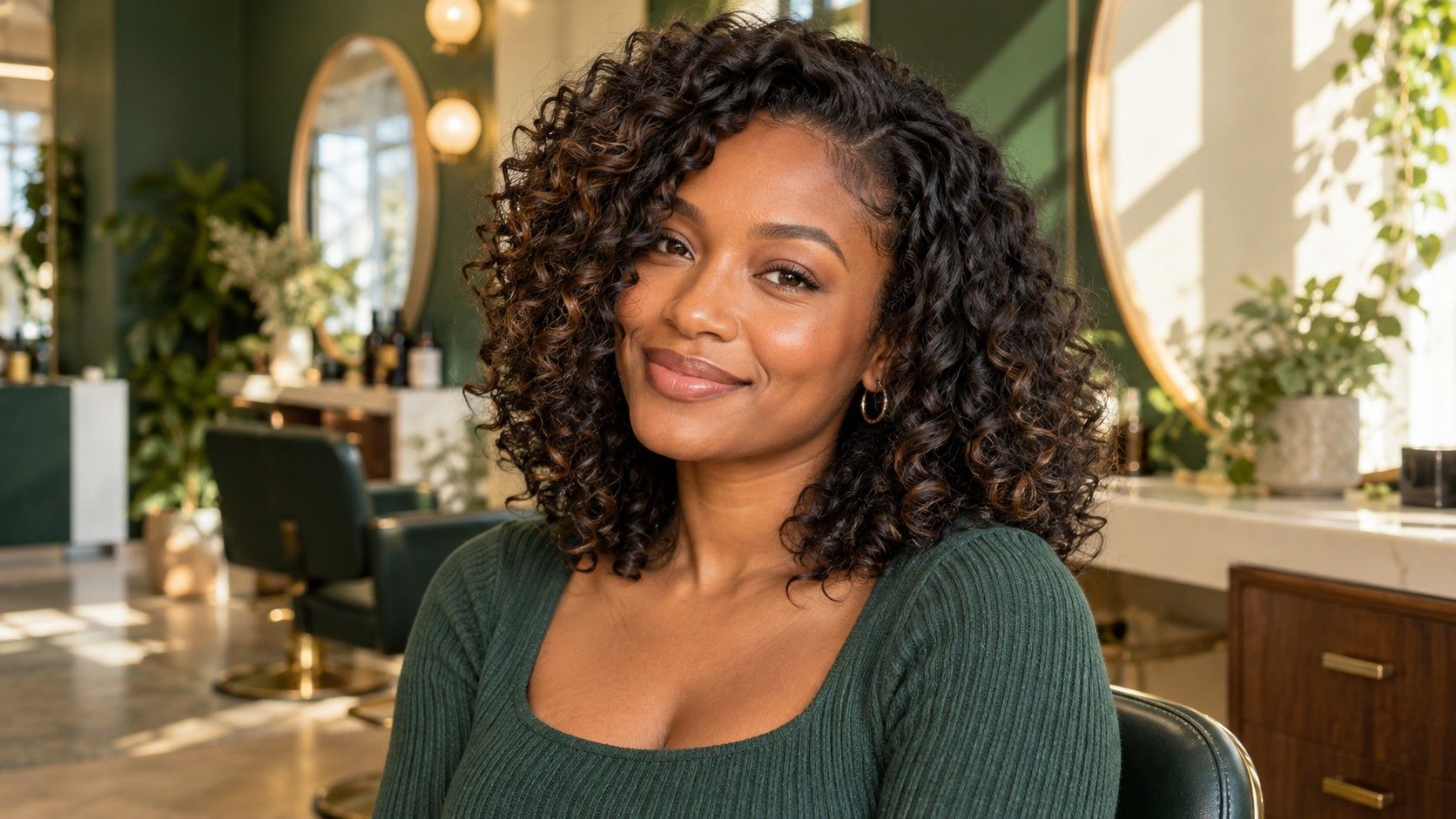
Curly bangs need to be planned in their dry shape. Stretching a curl can disguise how short it will sit when released. Bring a photograph of your own hair on an ordinary wash day and explain whether you diffuse, air dry or straighten the front. Ask for the fringe to be checked after it has settled. A conservative first length leaves room to adjust once you have seen how it behaves at home.
Waves can create an uneven edge even when the cut itself is even. One section may turn inward while another lifts away from the forehead. You might enjoy that looseness; if you want a smooth line, discuss the extra styling it may require. Fine straight fringe has a different challenge: strands can separate when they become oily or damp. Ask how to refresh the front without restyling all the hair, and use products sparingly until you know what it needs.
Try the routine with the tools you actually own. A salon finish produced with a large brush and careful sectioning may be hard to repeat with your fingers and a small dryer. Ask for the least complicated version and watch the direction in which the roots are dried. If the plan needs frequent heat styling, discuss an appropriate temperature and protection with the stylist rather than copying the salon's speed or settings blindly.
Plan the first trim and the eventual grow-out
Before the appointment, collect a small set of references and mark what you like about each. One may show the opening, another the density and a third the side length. Include a picture that is too short or too heavy for your taste. It gives the stylist a useful boundary. References with similar texture and density are more informative than a large album of unrelated fringe styles.
Ask which part will need attention first as the fringe grows. A brow-length edge can become uncomfortable before the rest of the cut feels longer; curtain pieces may lose their shape in another way. Agree how maintenance appointments work and whether the fringe can be adjusted gradually. There is no single trim interval that suits every cut, growth rate and tolerance for hair near the eyes.
It is also worth choosing a grow-out route while you still like the fringe. A longer side sweep, a central opening or small clips can help during the stage when the ends touch your eyes but do not reach behind your ears. If you already know you dislike clips and daily styling, begin with a longer frame. Choosing curtain bangs for your face shape, or any other fringe, becomes easier when the plan includes the weeks after the reference photograph.